Relative minor and major keys: how to find them, every pair, and parallel keys
Every major key has a relative minor that uses the same notes and key signature, three half steps below it: C major and A minor, G major and E minor. Here is how to find any relative key, all 12 pairs, and how relative and parallel keys are used in songs.
A relative minor is the minor key that shares its notes and key signature with a major key. Its home note is the sixth note of the major scale, three half steps (a minor third) below the major key's home note: the relative minor of C major is A minor. Going the other way, the relative major of a minor key starts on the minor scale's third note, three half steps up.
What is a relative minor?
Relative keys are a major and a minor key with the same key signature, so they use the same seven notes. What differs is the home note, the tonic, and with it the chord the music resolves to.
How to find the relative minor of any key
- Count down three half steps (a minor third) from the major key's home note: C, B, Bb, A. A minor.
- Or take the sixth note of the major scale: in G major (G A B C D E F#) the sixth is E, so the relative minor is E minor.
- To find the relative major of a minor key, count up three half steps, or take the third note of its scale: A minor's third note is C, so C major.
Spell it with the right letter: the relative minor's name is two letters below the major key's. Counting down from A major gives A, G#, G, then F# or Gb; two letters below A is F, so the relative minor of A major is F# minor, not Gb minor.
All 12 relative key pairs
| Major | Minor | Signature | Camelot |
|---|---|---|---|
| C major | A minor | None | 8B / 8A |
| G major | E minor | 1 sharp | 9B / 9A |
| D major | B minor | 2 sharps | 10B / 10A |
| A major | F# minor | 3 sharps | 11B / 11A |
| E major | C# minor | 4 sharps | 12B / 12A |
| B major | G# minor | 5 sharps | 1B / 1A |
| F# major | D# minor | 6 sharps | 2B / 2A |
| Db major | Bb minor | 5 flats | 3B / 3A |
| Ab major | F minor | 4 flats | 4B / 4A |
| Eb major | C minor | 3 flats | 5B / 5A |
| Bb major | G minor | 2 flats | 6B / 6A |
| F major | D minor | 1 flat | 7B / 7A |
On the Camelot wheel DJs use, relative keys share a number: B is the major key, A the minor. D# minor and Eb minor sound the same; the key and BPM finder calls it Eb minor. Three more key signatures exist (C# major, Gb major and Cb major with their minors), but they sound the same as the Db, F# and B rows. See the major and minor keys guide for every key signature.
Is a song in C major or A minor?
Because relative keys share their notes, the notes alone do not tell you. Listen for the home note: the chord the song resolves to and ends on, and the note the bass comes to rest on. One more clue: minor-key songs often raise the seventh note, so a G# (and with it an E major chord) points to A minor rather than C major.
Relative vs parallel keys
Parallel keys share a home note but not all their notes: C major and C minor are parallel keys. The parallel minor lowers the third, sixth and seventh notes of the major scale by a half step:
| Key | Notes lowered in the minor |
|---|---|
| C | E to Eb, A to Ab, B to Bb |
| G | B to Bb, E to Eb, F# to F |
| D | F# to F, B to Bb, C# to C |
| A | C# to C, F# to F, G# to G |
| E | G# to G, C# to C, D# to D |
| B | D# to D, G# to G, A# to A |
| F# | A# to A, D# to D, E# to E |
| Db | F to Fb, Bb to Bbb, C to Cb |
| Ab | C to Cb, F to Fb, G to Gb |
| Eb | G to Gb, C to Cb, D to Db |
| Bb | D to Db, G to Gb, A to Ab |
| F | A to Ab, D to Db, E to Eb |
Db minor and Ab minor are usually written C# minor and G# minor. On the keyboard Fb is E, Cb is B, Bbb is A and E# is F.
How are relative and parallel keys used in songs?
Relative keys share their chords. The chord on the sixth note of a major key (Am in C major) is the home chord of its relative minor, so a song can lean toward the minor key and back without a single new note. That is also why a key finder can read a song as its relative key: the key and BPM finder shows the relative key next to its result, and the home note decides.
Parallel keys lend chords. A borrowed chord is one taken briefly from the parallel key, without leaving the home key. In C major the borrows from C minor include Fm (iv) and the major chords Eb (bIII), Ab (bVI) and Bb (bVII), which are common in popular music. A rock progression that borrows Ab is I bVI IV, C Ab F in C, used by bands such as Genesis, Yes and Nirvana. In a minor key, a common borrow from the parallel major is the Picardy third: ending a minor-key section on a major home chord, such as A major in place of A minor at the end of a song in A minor. For progressions to try, see chord progressions in every key.
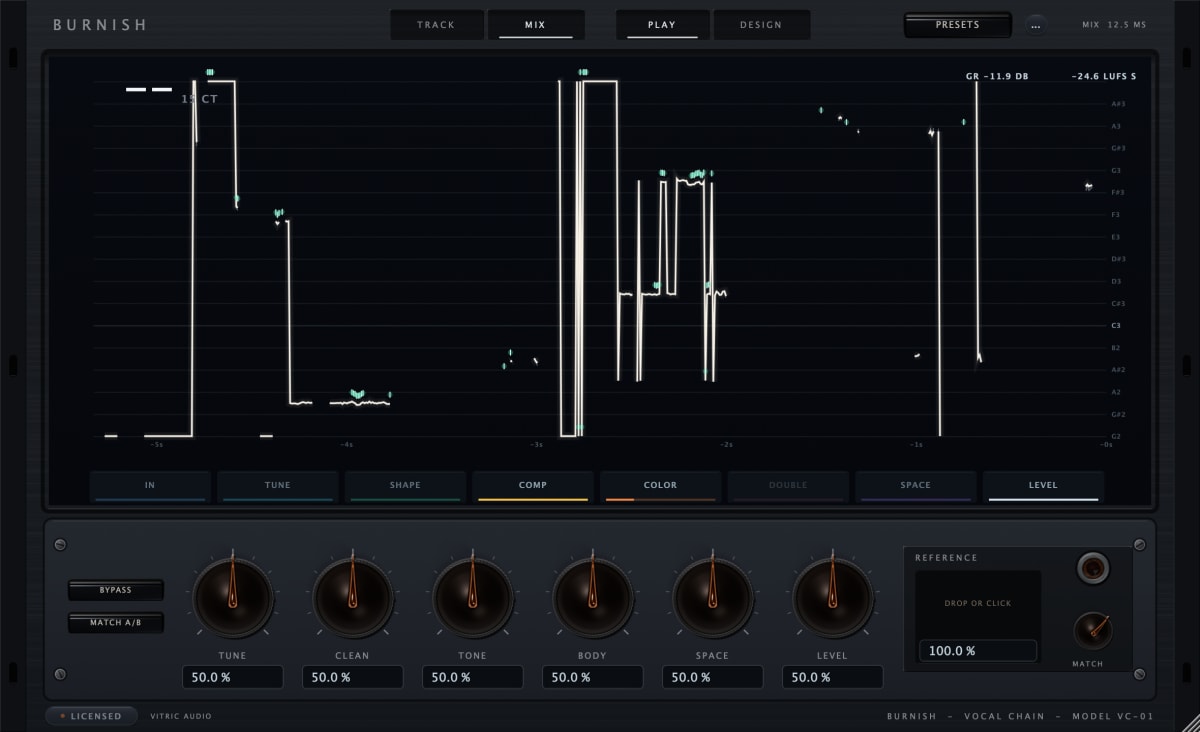
If you tune vocals in Burnish Vocal Chain, the TUNE station takes the key, the scale and the allowed notes. A minor and C major give the same target notes, so either works while the melody stays on those seven. If it also sings notes from outside them, such as a borrowed chord's Ab in C major or the G# of A harmonic minor, choose a scale that contains them (Harmonic Minor) or set the scale to Chromatic and switch off the notes the song never uses on the note keyboard.
Questions
What is the relative minor of C major?
A minor. Both have no sharps or flats.
What is the relative minor of G major?
E minor, with one sharp, F#.
What is the relative major of A minor?
C major: the third note of the A minor scale.
What is a parallel minor?
The minor key on the same home note as a major key: C minor is the parallel minor of C major.
What is the difference between relative and parallel keys?
Relative keys share their notes and key signature but not their home note (C major and A minor). Parallel keys share their home note but not all their notes (C major and C minor).