
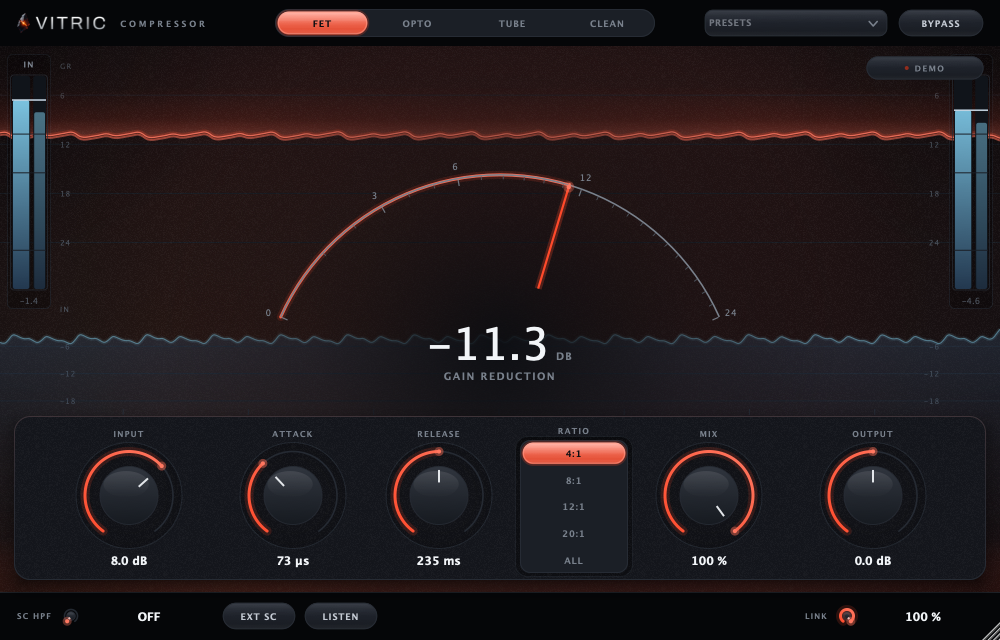
Forge Compressor in FET mode
Character Compressor
Forge Compressor
Four machines. One sheet of black glass.
FET, Opto, Tube and Clean: honest behavioural models of the studio classics in one unit. Switch modes and the whole machine re-lights.
Signal path
Why it exists
You know the drill. The drum bus wants FET grab, the vocal wants an opto that leans back, the mix bus wants tube glue, and the master wants nothing but control. That is four plugins, four interfaces, four gain-staging setups. This is one unit that actually behaves like each of those machines, because it models how they detect, not just how they curve.
The four modes
Watch the machine re-light.
01 · FET
FET. When the bus needs teeth.
The 1176 move: attack into the microseconds, fixed threshold, ratio buttons, and the ALL setting for that all-buttons-in explosion. Detection is feedback style, reading the already-compressed signal like the hardware does, with program-dependent release and asymmetric grit that scales with how hard you drive it. What you hear is punch: the hit stays, the ring behind it gets grabbed, and the tone picks up bite as you push.
02 · OPTO
Opto. The vocal leans back.
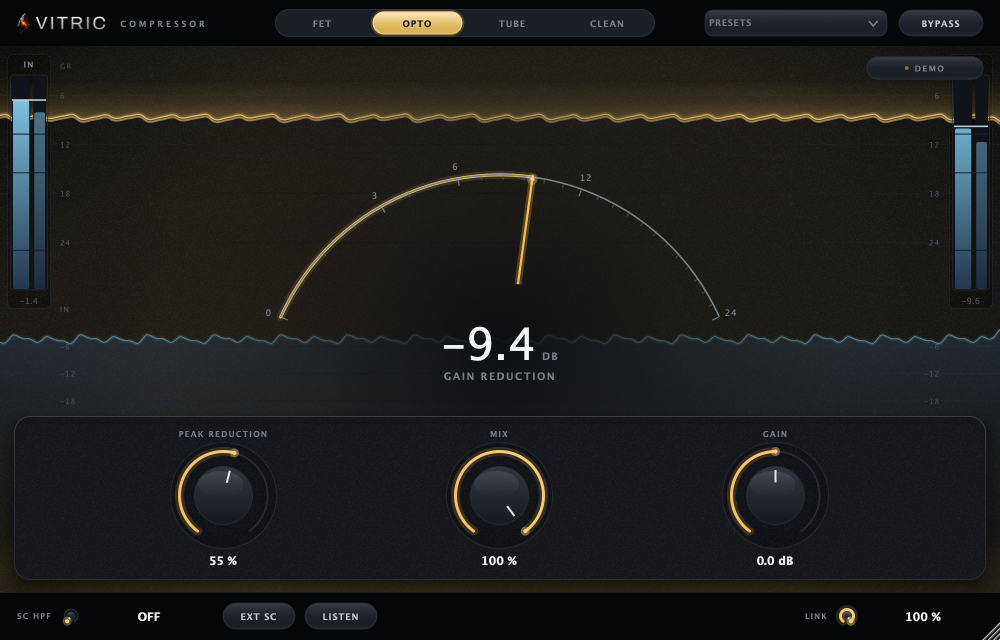
An LA-2A style cell with two-stage release and light memory: the harder it works, the slower it lets go. Peak reduction drives the detector only, so the audio path stays clean while the gain rides feel played rather than processed. Second-harmonic warmth rounds the top.
03 · TUBE
Tube. Glue you can hear.
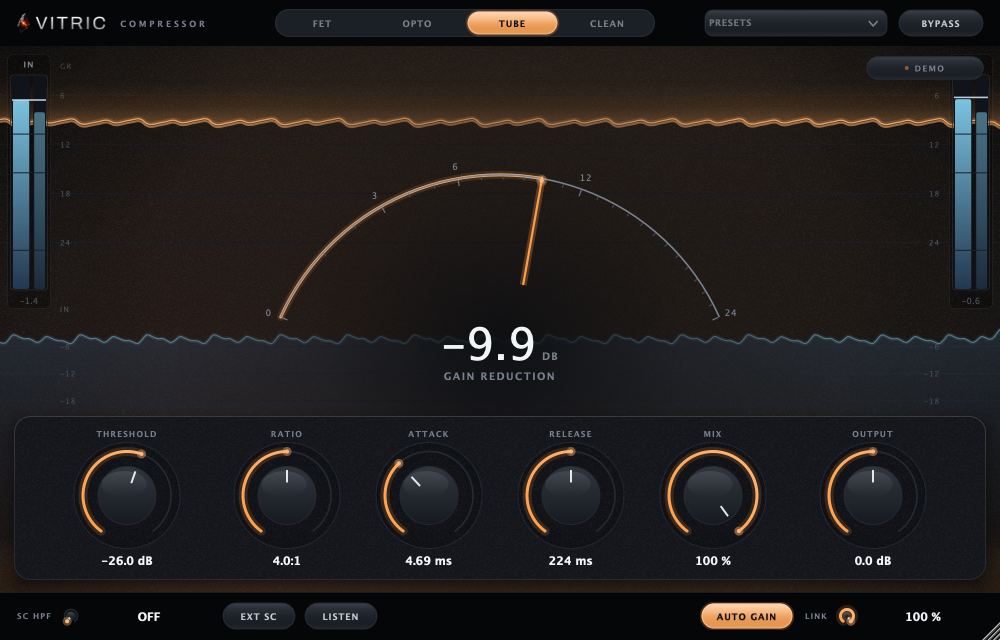
A CL 1B style wide knee that compresses long before the needle admits it, with biased-tanh harmonics and auto makeup. Push a mix bus 2 or 3 dB into it and the record holds hands without pumping.
04 · CLEAN
Clean. Control without opinion.
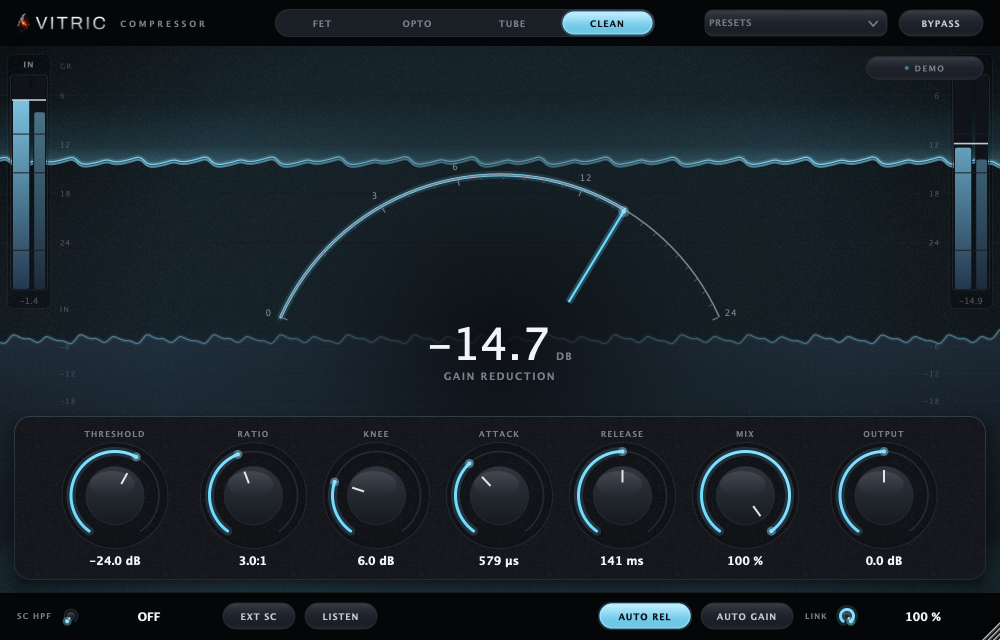
Feedforward detection with exact knee math, auto release, and zero added colour. When the master just needs a lid, Clean is textbook dynamics with nothing on top. Ice light, because nothing is cooking.
Where it earns its keep
Built for the jobs you actually have.
Drum bus
FET at 4:1 with the attack backed off lets the transient through, then grabs the room. Push into ALL for parallel crush on the mix knob.
Lead vocal
Opto rides a vocal the way the classic cell does: fast enough to catch, slow enough to breathe, releasing slower the harder the phrase pushes.
Mix bus glue
Tube with 1 to 3 dB of reduction and auto makeup. The wide knee starts working before you can hear it working.
Mastering lid
Clean mode with exact knee math and auto release keeps a master controlled without a fingerprint. Zero added latency, so it sits anywhere in the chain.
What's in the unit
Real pixels, not promises.
Four honest models
FET, Opto, Tube and Clean with distinct detection, ballistics and colour per mode. Built against the 1176, LA-2A and CL 1B workflows plus a transparent modern design.
Feedback-style detection
FET, Opto and Tube detect from the compressed output, like the hardware. That is where the classic softness lives.
Program-dependent release
FET release history and Opto's two-stage memory: work it harder and it releases slower, just like the real cells.
Colour that scales
Per-mode saturation after gain reduction. FET grit grows with drive, Tube and Opto add second-harmonic warmth, Clean adds nothing.
Full sidechain kit
External sidechain, sidechain high-pass filter, listen mode, and stereo link with a linked detector on the louder channel.
Mix, auto gain, true bypass
Parallel compression on the unit, auto makeup on Tube and Clean, and a click-free bypass crossfade.
Know which light to reach for
| Mode | Character | Detection | Reach for it on |
|---|---|---|---|
| FET | Fast, aggressive, gritty | Feedback, program-dependent release | Drum bus, parallel crush, bass |
| Opto | Slow, smooth, musical | Feedback, two-stage release with memory | Lead vocals, bass guitar, levelling |
| Tube | Warm, rounded, forgiving | Feedback, wide soft knee | Mix bus glue, keys, full mixes |
| Clean | Transparent, exact | Feedforward, exact knee math | Mastering, anything that must stay pure |
Everything in the box
- Four compressor circuits: FET, Opto, Tube, Clean
- Feedback-style detection on FET, Opto and Tube
- FET: microsecond attack, ratio buttons 4:1 to 20:1 plus ALL
- Opto: two-stage release with light memory
- Tube: wide soft knee with auto makeup
- Clean: feedforward with exact knee math and auto release
- Per-mode saturation stages, from FET grit to identity
- External sidechain input with high-pass filter and listen mode
- Stereo link, 0 to 100 %, detector on the louder channel
- Mix control for parallel compression on the unit
- Click-free bypass crossfade
- Zero samples of added latency in every mode
- Real attack and release readouts in ms and µs per mode
- Factory presets, full state recall, total automation
- VST3, AU and AAX, Windows and macOS
Specifications
Questions engineers ask
Is the FET mode like an 1176?
It is built against that workflow: attack into the microseconds, fixed threshold with the input driving the compression, ratio buttons, and an ALL mode for the all-buttons-in sound. Detection is feedback style with program-dependent release, which is where the hardware's character comes from.
What is the difference between the four modes?
They are four separate circuit behaviours, not one engine with presets. FET is fast and gritty, Opto rides slowly with release memory, Tube glues through a wide knee with warmth, and Clean is a transparent feedforward design. Each mode has its own detection, ballistics and saturation.
Does it add latency?
No. Every mode runs at zero samples of added latency, so it works anywhere: tracking chains, mix bus, mastering.
Can I sidechain it from another track?
Yes. It accepts an external sidechain in every DAW that routes one, with a sidechain high-pass filter and a listen mode so you can hear exactly what the detector hears.
Is there a free trial?
Yes. Every Vitric plugin ships with a free 14 day trial: the full plugin, every feature, no locks. Installers and trial keys land on the downloads page the day the store opens. When the 14 days end, the plugin keeps loading in your sessions in a graceful demo mode.
More from the line
Forge Compressor
One insert. Four rooms.
Drum bus, vocal chain, mix glue, mastering lid. Same unit, different light.